
“Academic freedom enables entirely new breakthroughs and innovation” – Collaboration between University of Oulu and Metsä Group creates new value from side streams
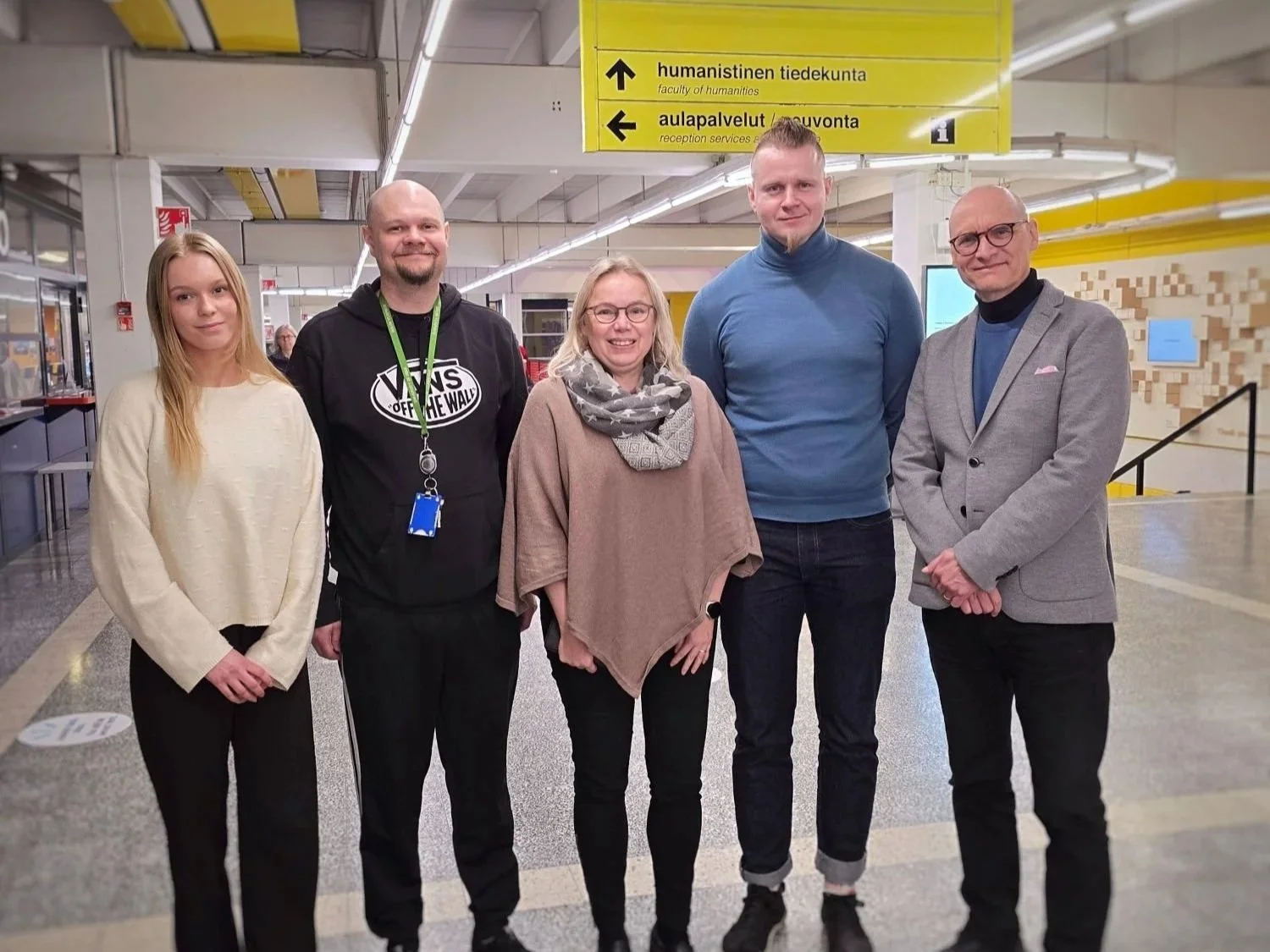
Anni Tauriainen (left), Janne Pesonen, Ulla Lassi and Toni Kauppinen from the University of Oulu, together with Kari Ala-Kaila (right) from Metsä Group, are developing new expertise and innovations to improve the utilisation of side streams in the forest industry.
“Collaboration between researchers and companies works best when a shared challenge is identified – one that takes both partners into new territory and may even transform an entire field”, says Professor Ulla Lassi, Head of the Research Unit of Sustainable Chemistry at the University of Oulu.
Her research group develops inorganic materials such as battery chemicals, catalysts, adsorbents, and process chemistry solutions that support the circular economy and improve industrial resource efficiency. The research is carried out in close cooperation with companies and is strongly application-oriented and practice-driven.
The collaboration between the University of Oulu and Metsä Group is a strong example of this approach. Metsä Group aims to utilise northern wood as efficiently as possible, and through research collaboration, new expertise is developed and innovations are advanced to ensure that all production side streams are put to effective use. The partnership between Metsä Group and the University of Oulu has continued for a long time through both publicly funded projects and contract research.
“Our collaboration is not simply about funding academic research – it is strategic development. We have our own goals that align well with researchers’ expertise”, says Kari Ala-Kaila, Development Director at Metsä Group.
Ulla Lassi’s team works with Metsä Group particularly on industrial side streams from the forest industry and their higher-value utilization. Traditionally, by-products from pulp and paper production have been used mainly for energy generation, but there is now a clear ambition to identify solutions with higher added value and new applications.
“Side streams are not Metsä Group’s core business, but from the perspective of the entire value chain and sustainability, their utilization is extremely important”, Lassi explains.
One concrete example of this work is the SECRES project, funded by Business Finland. In the project, the University of Oulu, Metsä Group and other partners developed solutions for utilizing side streams from the forest, chemical, mining and metal industries as raw materials in other industrial sectors, such as the concrete industry or fertilizer production.
Researchers at the University of Oulu have also developed high-performance bio-based resins from abundant forestry and agricultural side streams, offering a sustainable alternative to conventional oil-based materials in composite products.
Keys to success: trust, communication and expertise
How has the collaboration between the University of Oulu and Metsä Group produced results that benefit both parties and even have the potential to transform the forest industry? From both the company’s and the researchers’ perspectives, successful collaboration is built on trust, open dialogue, and strong expertise.
According to Ulla Lassi, mutual trust is reflected above all in academic freedom, which makes it possible to examine challenges beyond a company’s core operations and established solution models.
“In our joint projects, the starting point is the challenges defined by Metsä Group, but we are given free hands to solve them. Academic freedom enables entirely new approaches and innovation. Our collaboration is genuine research work and the creation of new knowledge – research at its very best”, Lassi describes. “Through the projects, my own perspective on the utilization of side streams has evolved significantly.”
Both parties also emphasize the importance of open, honest, and continuous communication. Ala-Kaila particularly values the social skills of Lassi’s team.
“The attitude of Ulla and her team is enthusiastic and solution-oriented. Personal chemistry works well, and we are very much on the same wavelength. There is always someone in the team to discuss both new ideas and the evaluation of ongoing work”, Ala-Kaila says. “The team also demonstrates strong situational awareness, social capability and a genuine interest in the project. This fuels dialogue and innovation.”
Ala-Kaila points out that flexibility is also essential for effective collaboration. Plans can never be perfect in advance, as unexpected developments are always possible. Both sides therefore need the ability to adapt. According to Lassi, this mutual understanding is reflected in the ability to discuss issues openly.
“We don’t need sugar-coat things. If something doesn’t work or we don’t find a solution, we can say it honestly. Then we approach the problem from another angle”, she says.
How could research collaboration help your company succeed?
Does your company have a new development need, an idea, or questions related to sustainability or process development? The experts at the University of Oulu Innovation Centre are happy to help.
Get in touch so we can review your situation together, identify new opportunities and explore collaboration models that best suit your needs.
Kaisa Still, Customer Manager, Company Collaboration
kaisa.still(at)oulu.fi
+358 40 150 8741
Maria Juurikka, Customer Manager
maria.juurikka(at)oulu.fi
+358294487646
Petri Leukkunen, Customer Manager
petri.leukkunen(at)oulu.fi
+358 29 448 1162