
“Professional development happens unbelievably fast” – Geography alumni Joni Viitala is impressed by EU traineeship in Brussels
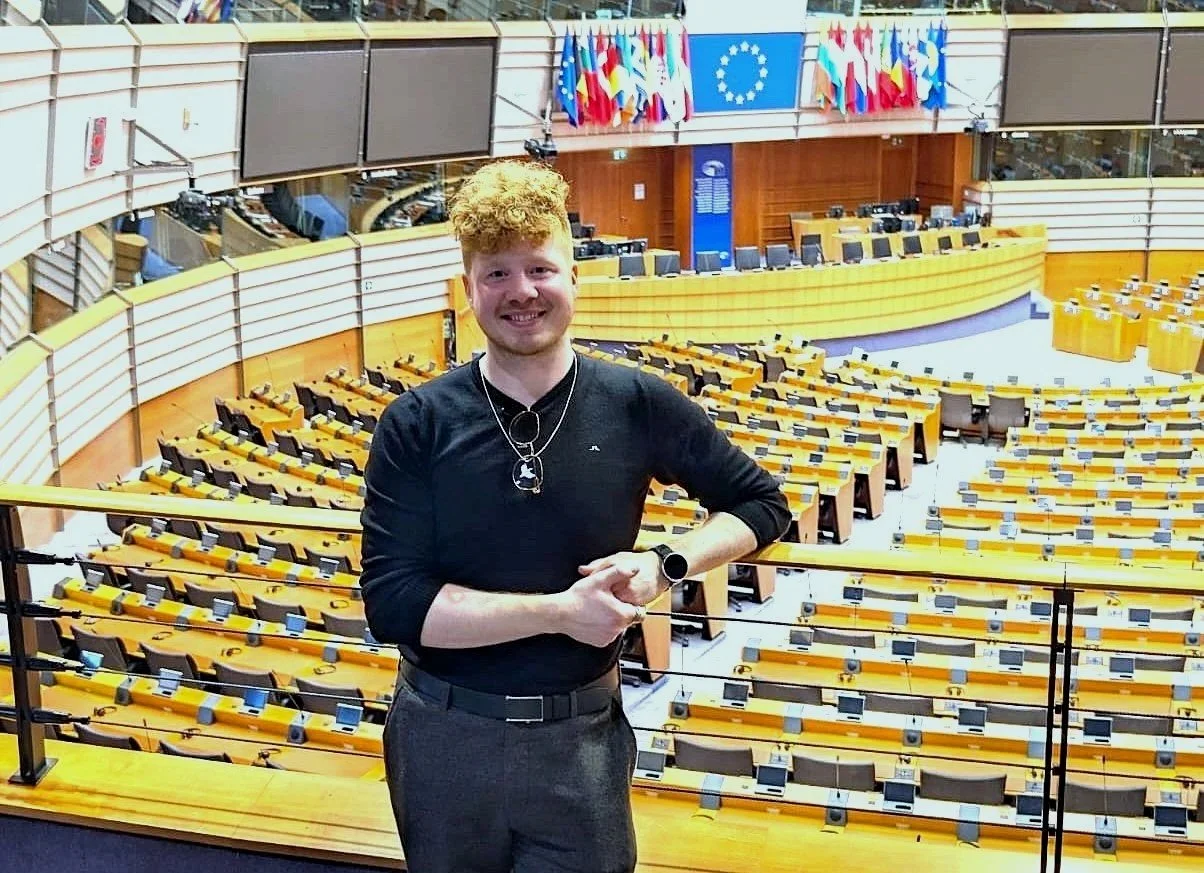
Joni Viitala went to Brussels for an EU traineeship. In the photo, he is in the Parliament’s plenary chamber.
When Joni Viitala, who graduated in geography from the University of Oulu, packed his bags in the autumn of 2025 and headed for Brussels, he did not yet fully know what a traineeship at the East and North Finland EU Office would bring. Two months later, his feelings are clear: the experience has been exceptionally enriching both professionally and personally.
“Professional development happens unbelievably fast. Here, your own expertise really becomes concrete”, Joni explains.
After graduating, Joni thought that traineeships mainly belonged to student life. In Brussels, he quickly realised that in the EU field, career paths very often go through traineeships. The city is home to a large number of recent graduates who are just taking their first steps in international roles. Every year, more than 2 000 trainees enter EU institutions to develop their professional skills, build networks and make use of the knowledge they acquired in their studies. In addition, thousands of trainees work every year with EU affairs in other organisations.
A route to Brussels driven by curiosity
EU affairs had already interested Joni during his studies, especially in courses on regional development and policy, which explored EU influence and how regulations and decisions are reflected even in small choices.
“The EU’s impact extends everywhere – even to very everyday and small things, such as the sustainability of the beans in your morning coffee. That made me understand how vast a whole the Union really is.”
The traineeship at the EU Office eventually came about when a geography alumni sent a message to a student mailing list about an open position. Each spring, the EU Office recruits trainees for a ten-month traineeship through an open call for applications.
“I decided to apply because I was interested in an international and versatile traineeship position. I believe that, in addition to my studies, my interest was also influenced by the European Geography Association (EGEA). This network connects students from dozens of cities across Europe and organises, among other things, short cultural exchange programmes and conferences. The organisation encourages international cooperation and networking.”
Joni also mentions the Arctic Frontiers conference, to which the University of Oulu offered students access, as a valuable experience.
Joni describes the application process as clear and straightforward: after submitting his application, he was invited to a remote interview, after which the position was confirmed.
“As an EU trainee, you can get involved in many things”
Joni’s daily life in Brussels has been intense but exciting. In his work, he produces communications, writes newsletters, updates websites, works on event production, reports on seminars and keeps track of current developments in EU policy. He also participates in advocacy work and gets a close-up view of how different regional perspectives influence legislative processes.
“As an EU trainee, you can get involved in many things if you want to. There is no strict hierarchy here, and people are open. I was able to start working with experienced experts right away.”
Brussels itself continuously offers new things to learn and experience. “The city is full of culture and events – there’s something to do from morning to night!” Joni laughs.
Geography studies provided a strong foundation
Joni’s geography studies have proved extremely useful in his work. Managing broad entities, the ability to read and analyse reports, information-seeking skills, and an understanding of the interaction between society and nature are all directly applicable in the EU environment. In addition, a geographical perspective brings valuable expertise in identifying regional differences, interpreting statistics and map data, and understanding the impacts of policy in different areas.
“Instead of traditional exams, in geography you often produce and search for information. That has been absolutely essential here. It has also been great to bring my own knowledge of nature into discussions, as the Arctic regions and sustainability issues are a big part of this work.”
When Joni reflects on the best part of the traineeship, the answer comes quickly: the people. There is a huge number of both young and experienced professionals working in Brussels who are willing to share their expertise.
“Through this traineeship, I’ve met amazing people. Sometimes this job feels almost like a paid hobby because it’s so interesting. And then it doesn’t feel as burdensome either,” Joni says.
He is also pleased to see that Finnish work culture seems to be appreciated in Brussels. The practical, clear and reliable way of working associated with northern Finland has received a lot of praise. The ability to see opportunities in the Arctic regions, rather than only challenges, is also a strength in the EU environment.
EU traineeship offers something for everyone
In Joni’s opinion, an EU traineeship can be recommended to almost anyone. It offers an opportunity to see how a large system operates and opens doors in many directions. However, the work requires initiative, courage and a willingness to get to know people.
“Networking is extremely important. But you don’t have to be a superhuman here. It’s enough to be curious and ready to learn.”
Working in EU-related roles also interests Joni after the traineeship. At the same time, Finland attracts him as an environment where it is easy to build a personal life.
“Fortunately, EU expertise is also needed in Finland, so all doors are open!” Joni says.
How to apply for an EU career
The EU public administration is a unique working environment. The EU recruits officials from all over the European Union and communicates in 24 different languages, forming a diverse, multicultural and multilingual group unlike any other.
Tiina Haapalainen, Communications Specialist at the Council of Oulu region, reminds that pursuing an EU career requires persistence, but it is worth it.
“Applying for an EU career requires groundwork, preparation and initiative, but it pays off. Not all positions require previous work experience. For example, the AD5 competition is intended for recent graduates who do not yet have work experience. I recommend following the website where information about the launch of the competition and other job opportunities will be published”, Haapalainen says.
The next AD5 competition will be published at the beginning of 2026. The competition tests, among other things, reasoning skills, digital competence and knowledge of the EU, and the best applicants are placed on a reserve list from which a path to an actual job interview may open up.
The career pages of the European Commission Representation in Finland also provide a comprehensive overview of other tips on how to get started on an EU career. The EU offers a wide range of permanent and fixed-term positions as well as traineeship programmes, such as the Commission’s Blue Book. Diverse information about working in the EU can also be found on the Eurooppalainen Suomi website (in Finnish), which is particularly useful for students and recent graduates exploring career options.