
What if emissions from the steel industry could be reduced by as much as 90 percent? Collaboration between the University of Oulu and SSAB aims for impressive results
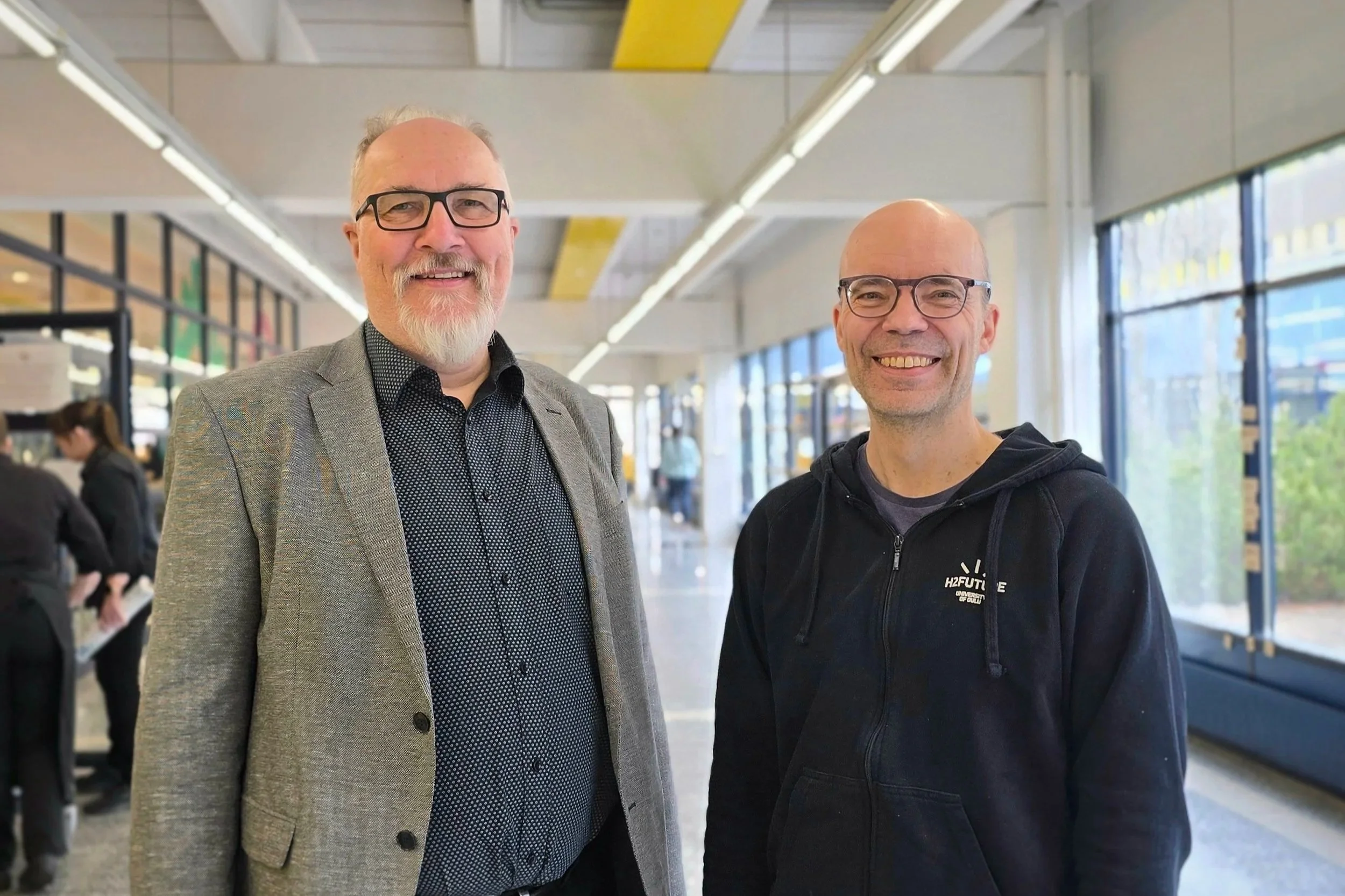
Professors Jukka Kömi (left) and Timo Fabritius are working with SSAB to develop solutions that reduce emissions from the steel industry without compromising steel quality.
The steel industry is undergoing a global transformation as production shifts towards solutions based on electricity, recycled steel and hydrogen-based processes. In the collaboration between the University of Oulu and SSAB, the transition is examined across the entire value chain: how steel is produced, what properties will be required of future steels, and how research findings can be put into practice in industry and among its customer companies.
“SSAB is making a major strategic shift towards sustainable special and premium steels. The change requires close cooperation with research institutions. The entire chain must be involved, from raw materials and production to maintenance, product and process development, and deliveries”, says Pasi Suikkanen, Product Development Manager at SSAB. “This enables us to put strategic objectives into practice faster and in a more controlled way.”
The collaboration is advanced, for example, by Jukka Kömi, Professor and Head of the Materials and Mechanical Engineering Research Unit at the University of Oulu, and Timo Fabritius, Professor and Head of the Process Metallurgy Research Unit. Kömi’s research focuses on steels, products and their manufacturing chains, while Fabritius concentrates on steelmaking processes and their renewal. Both areas offer opportunities that may transform the entire steel industry in the future.
Collaboration covers major projects that renew the entire value chain
The steel industry accounts for approximately 7–9 percent of global carbon dioxide emissions, making it one of the world’s most polluting industries. The transition of one large steel mill to electric and hydrogen-based production could cut Finland’s carbon dioxide emissions by as much as 7 percent. SSAB is one of the world’s most advanced steel producers. Its aim is to revolutionise steelmaking through research-based innovations and steel that generates virtually no fossil carbon dioxide emissions. Researchers and SSAB experts therefore face both genuine opportunities and challenges as they develop new solutions.
“The most interesting aspect of our collaboration is that we can be deeply involved in SSAB’s operating processes and, as researchers, see where the global steel industry is heading. Together, we are developing future products and manufacturing solutions that have a truly significant impact on both industry and the climate”, Kömi says.
“In Finland, the steel industry produces more than 4 000 000 tonnes of carbon dioxide emissions annually, which is equivalent to the emissions from the entire transport sector. If these emissions can be reduced by as much as 90%, the impact will be enormous”, Fabritius adds.
The effects also extend to steel users: stronger steels enable lighter structures, which can reduce the need for materials and energy consumption. This is one of the aims of RIS4E, a joint project of the University of Oulu and SSAB that develops ultra-high-strength, low-carbon steel grades as well as factory and manufacturing simulations. The three-year project has a budget of EUR 23 million and involves end users of steel from sectors such as marine engineering, cranes and forestry machinery. In inverse design, research begins with the requirements of the end product and works backwards to the steel mill, allowing the properties of the steel and the manufacturing process to be matched more precisely.
The RIS4E project is part of the Sustainable World through Steels leading-company programme funded by Business Finland and led by SSAB. The programme significantly expands research and development activities in Finland, and the estimated cost of SSAB’s leading-company project is EUR 50 million. Its goal is to build a world-class ecosystem in Finland for producing and using ultra-high-strength, fossil-free steels and to make the country’s steel industry low-carbon by 2035. For the University of Oulu, the partnership provides access to the global steel industry.
The FutSteel project was also selected for the programme. Led by the University of Oulu and SSAB, it renews the entire steelmaking chain by combining electricity-based electric arc furnace technology with modernised hot-rolling processes. The three-year project has a budget of EUR 17 million. Its aim is to find solutions for transforming the production system at the Raahe mill into a low-carbon system without compromising steel quality or delivery capability.
Mutual trust enables ambitious research
The collaboration between the University of Oulu and SSAB has an exceptionally long history, dating back to the 1960s. Broader joint research projects began in the 1980s. Over the decades, the partnership has grown into one of the University of Oulu’s longest-standing and most important corporate collaborations.
“The long history brings deep mutual understanding to the collaboration, which in turn often enables academic freedom. When the parties know each other’s goals, operating methods and expertise, the research can also tackle challenging, long-term questions”, Kömi explains.
“The importance of the collaboration must be recognised all the way up to the company’s top management so that the best conditions can be created for developing solutions together. The same naturally applies in the other direction as well”, Fabritius says.
Kömi and Fabritius also encourage young researchers to engage in company collaboration, as it helps, among other things, with obtaining funding and expanding professional networks. Above all, it is an excellent way to put research into practice.
“Company collaboration gives research impact. No matter how well fundamental research is conducted, its societal benefit will always remain uncertain without collaboration with companies”, Kömi says.
Kömi and Fabritius are pleased that the long-standing collaboration between the University of Oulu and SSAB provides an opportunity to build expertise in Finland that serves companies and society both nationally and internationally.
“Finland is a steel country. Our steel research is world-class, and SSAB is one of the world’s most advanced steel producers. I believe that together we can create solutions for the steel industry that generate virtually no fossil carbon dioxide emissions”, Fabritius concludes.
Interested in research collaboration with the University of Oulu? Contact the Innovation Centre, and let’s discuss your needs and suitable forms of collaboration.
Maria Juurikka, Customer Manager
maria.juurikka(at)oulu.fi
+358294487646
Petri Leukkunen, Customer Manager
petri.leukkunen(at)oulu.fi
+358294481162
Kaisa Still, Customer Manager
kaisa.still(at)oulu.fi
+358294488030